
Forklift Battery Charger Sizing Guide: Amps, AH, and Charge Time
Forklift battery charger sizing guide — Learn how to match voltage, amps, and AH capacity for optimal charging. Includes one-shift vs multi-shift advice, chemistry considerations, and why PBM chargers are a popular choice.
Published May 8, 2026 · Updated May 13, 2026
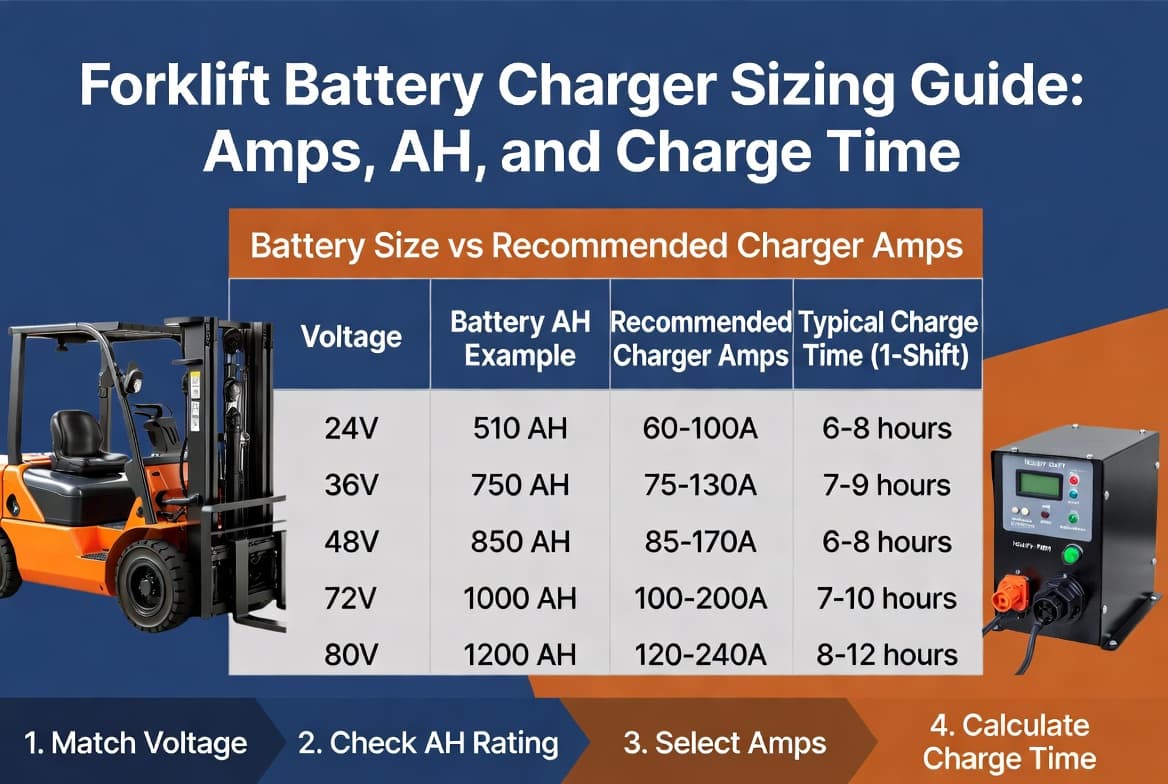
Quick Answer
To correctly size a forklift battery charger, match the charger voltage to the battery voltage, then choose the right output amperage based on the battery’s amp-hour (AH) capacity and your desired charge time.A charger that is too small will leave batteries undercharged. A charger that is too large (or mismatched) can overheat the battery and shorten its life. PBM forklift chargers are available across common voltage and amp ranges, making them a practical option for many warehouses and equipment dealers.
What Does Forklift Battery Charger Sizing Mean?
Sizing a forklift battery charger means selecting a unit that safely and efficiently recharges your battery based on how your equipment is used. Proper sizing helps:
Reduce downtime
Extend battery life
Prevent overheating
Ensure consistent daily performance
Match your facility’s power supply
Sizing involves four key factors:
Battery voltage
Battery amp-hour (AH) capacity
Charger output amperage
Charge profile and battery chemistry
Step 1: Match Charger Voltage to Battery Voltage
This is the most important rule.
The charger’s output voltage must exactly match the battery voltage.
Common Voltages:
12V → Specialty / small equipment
24V → Pallet jacks, walkie stackers
36V → Older forklifts
48V → Most common electric forklifts
72V → Heavy-duty equipment
80V → Large forklifts & high-demand fleets
Never guess. Check the battery nameplate or count the cells (2 volts per cell for lead-acid).
Step 2: Determine Battery Amp-Hour (AH) Capacity
The AH rating tells you how much energy the battery can store. Larger AH batteries need more charger power or longer charge times.You’ll find this number on the battery nameplate (e.g., 48V 850 AH).
Step 3: Choose the Right Charger Output Amps
Charger amps determine how fast energy is returned to the battery.
General Rule of Thumb for Lead-Acid Batteries:
Charger output amps ≈ 10% to 20% of battery AH capacity
Examples:
600 AH battery → 60–120A charger
750 AH battery → 75–150A charger
850 AH battery → 85–170A charger
Higher amps = faster charging (good for multi-shift operations).
Lower amps = safer for overnight / single-shift charging.
Step 4: Calculate Approximate Charge Time
Rough Formula:
Amp-hours to replace ÷ Charger output amps = Charge time (hours)
Real-world note: Actual time is longer because current tapers during finish and equalize stages.
One-Shift vs Multi-Shift Charging
Operation Type | Recommended Approach | Charger Needs |
|---|---|---|
One Shift | Overnight charging | Standard output (10–15% AH) |
Multi-Shift | Fast turnaround or opportunity charging | Higher output + 3-phase power |
Battery Chemistry Considerations
Flooded Lead-Acid — Most common. Needs proper finish & equalize charging.
AGM / Gel — More sensitive. Requires specific charge profiles.
Lithium — Needs BMS communication. Standard lead-acid chargers are usually not compatible.
Input Power Requirements
Larger chargers (especially high-amp models) usually require three-phase power (208V/240V/480V).
Smaller chargers can often run on single-phase power.
Always match the charger’s input requirements to your building’s electrical service.
Signs Your Charger Is Wrongly Sized
Too Small:
Battery not fully charged before next shift
Decreasing forklift runtime
Frequent battery swapping
Too Large / Mismatched:
Battery gets very hot
Excessive water loss (flooded batteries)
Strong sulfur smell
Charger faults or blown fuses
Why PBM Chargers Are a Strong Sizing Option
PBM industrial chargers are popular because they come in a wide range of voltages (12V–80V) and amperages. They are:
Practical for both single-shift and multi-shift use
Available in single-phase and three-phase models
Easier to service than many proprietary OEM chargers
Cost-effective for warehouses, dealers, and refurbishes
What to Gather Before Buying
Battery voltage
Battery AH rating
Battery chemistry
Daily operating hours / shifts
Desired charge time
Available AC input power (phase + voltage)
Connector type
Bottom Line
Properly sizing a forklift battery charger is critical for performance and battery longevity. Always match voltage exactly, then select amperage based on AH capacity and your shift schedule.
A correctly sized PBM forklift charger can deliver reliable, cost-effective charging for 12V through 80V systems in both single-phase and three-phase environments.
FAQ
How do I know what amp charger I need?
Generally 10–20% of your battery’s AH rating. For example, a 750 AH battery often uses a 75–150A charger.
Can I use a higher amp charger to charge faster?
Yes — but only if the battery and charger profile support it. Too much current can cause heat damage.
Does voltage or amperage matter more?
Voltage must match exactly. Amperage controls speed and must be appropriate for the battery size.
Can PBM chargers handle multi-shift operations?
Yes. Many PBM models are available in high-output three-phase configurations suitable for heavy daily use.
Related guides
 Why Buy PBM
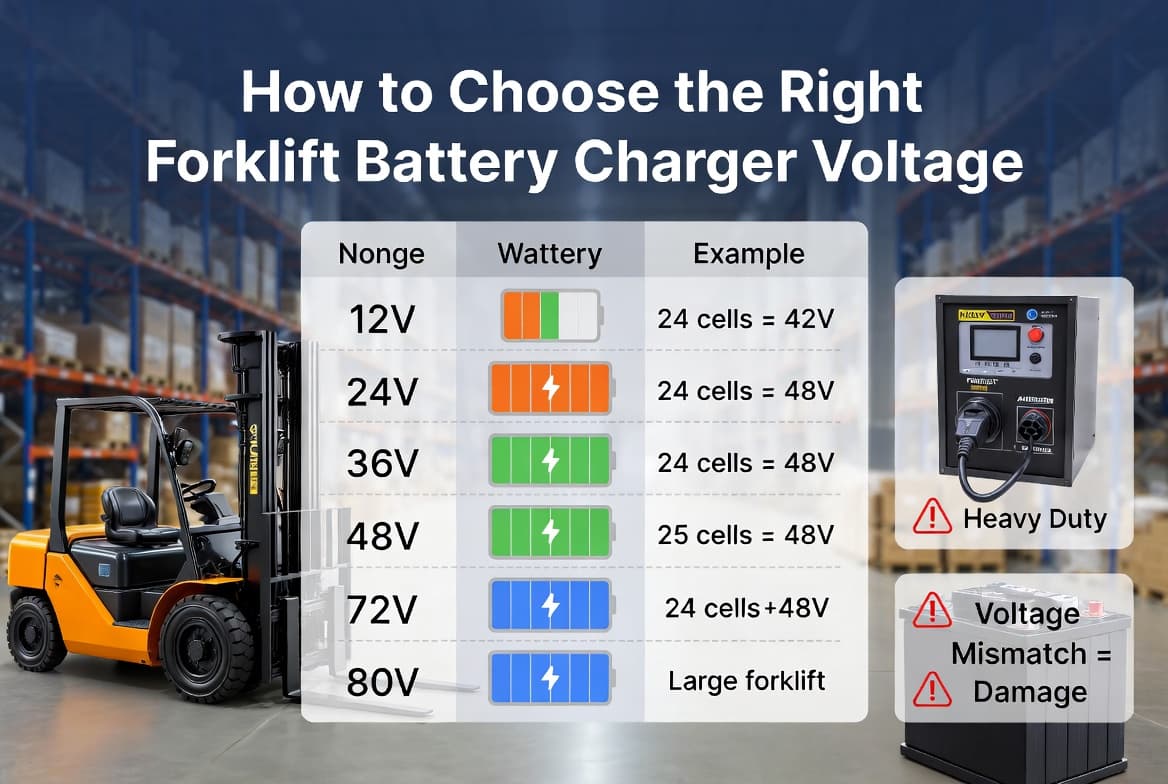
How to Choose the Right Battery Charger Voltage | 12V–80V Guide
Choosing the right battery charger voltage is critical for safety and battery life. This guide explains 12V, 24V, 36V, 48V, 72V, and 80V systems, how to read battery nameplates, cell counts, and why voltage matching matters when using PBM or other industrial chargers.
 Why Buy PBM
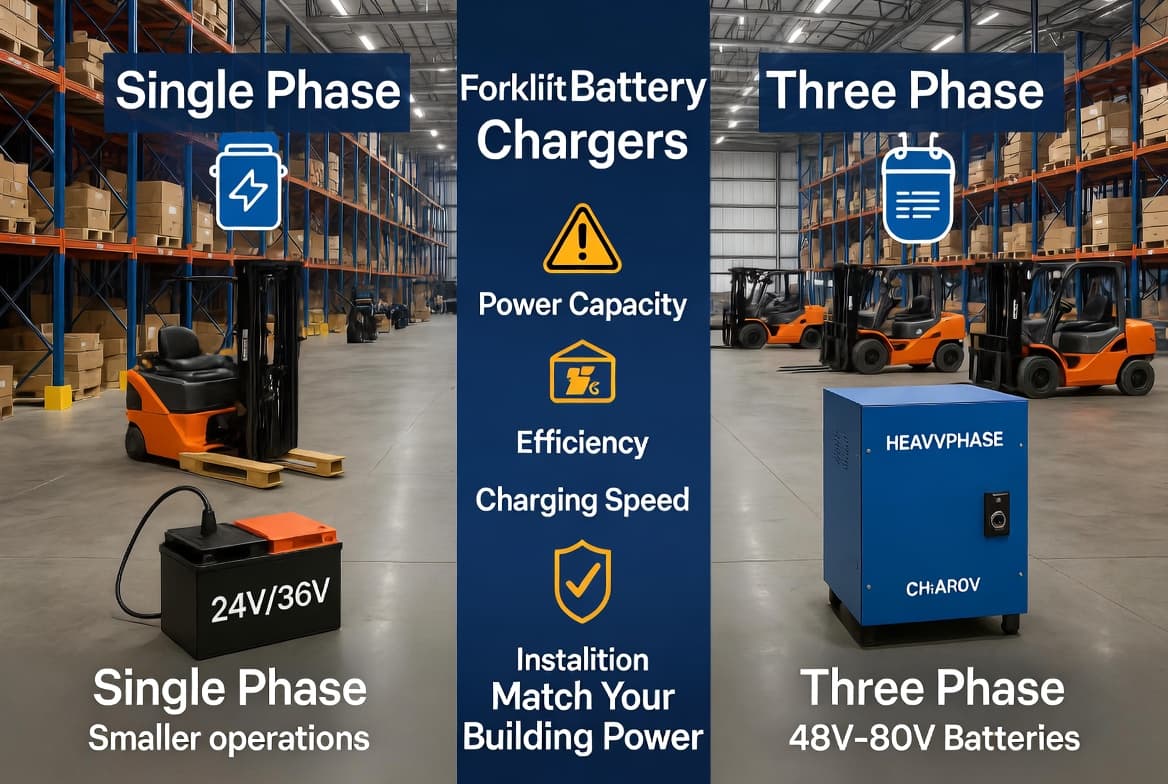
Single Phase vs Three Phase Battery Chargers | Which One Do You Need?
Single phase vs three phase battery chargers — which is right for your warehouse? This guide explains power requirements, efficiency, charging speed, and how to choose the best option for your operation, including PBM charger recommendations.
 Why Buy PBM
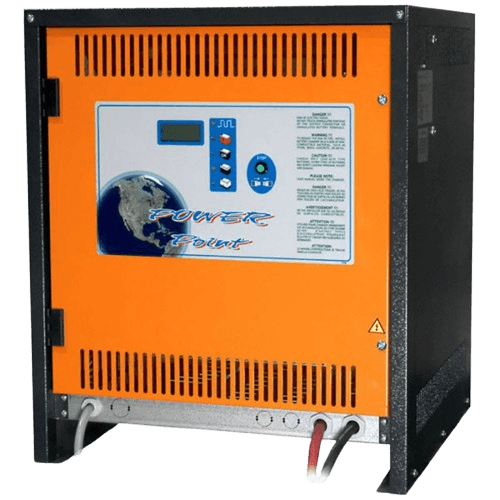
PBM Chargers: What They Are, What They Can Do, and How They Compare
Learn what PBM chargers are, how they work, and why they’re a popular, cost-effective choice for warehouses and used equipment dealers. Full breakdown of voltages, features, and buying tips.